I've been in the mood for some vintage Nicholson lately. I keep telling myself that One Flew Over The Cuckoo's Nest would be a good one to watch. Maybe some Chinatown. Or a little Easy Rider. Hell, I even thought about adding The Shining to the top of my Netflix queue. As a matter of fact, I began streaming Five Easy Pieces the other night, but I was grabbing a bunk connection and the choppiness was getting to me so I turned it off. So it's to be totally expected that when I sat down for some late evening entertainment last night, I entrust my senses with...what else? Fuckin' Friday Night Lights.
I've never really taken the time to enjoy the the TV show based on this movie, but watching this piece of shit film made me understand why it gets the praise that it does. I've heard that the show is more character-driven and not so singularly focused on football, which, after seeing the movie, must have had something to do with Peter Berg's guilty conscience about directing a movie that failed to create any kind of character depth at all. It was fuckin' atrocious. In the right hands this movie could have dethroned Raging Bull as The Godfather of all sports movies, or at least nipped at Raging Bull's heels. My little brother had read the book, and one thing I picked up from his analysis was how much of an emotional crutch high school football is in small town Texas and how vital it would be to relay that in a film adaptation, but the only way Berg could get this idea across in the movie was to rehash a sports movie cliché
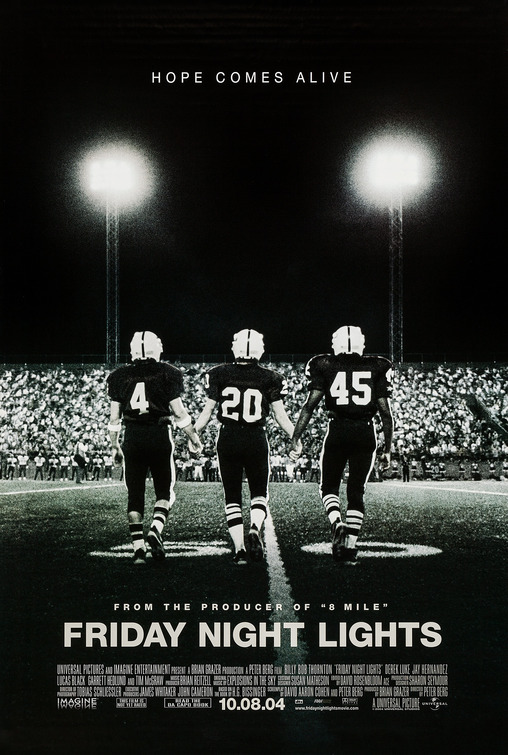 by showing a quick montage of the entire town shutting down to watch the big game of the week. While the book (and I presume the TV show) tended to shine a spotlight on the town's social, economic, and racial divides and how the town depended on the football team to temporarily eliminate them, the movie did next to nothing in exploring these themes, and turned out nothing that no one hadn't seen before. I didn't get the impression that the movie even lived up to its own poster, a b/w photo of three dudes holding hands as they take the field for the coin toss, as if to indicate a rare and inspiring form of camaraderie and intimacy carried out by the Odessa-Permian Panthers. Fell a little short of that one too. It makes sense that the TV show is so lauded for its character development, simply because a serial drama has the kind of time to develop and expand on that sort of thing in a way that a movie never could (But, in thinking about it that way, you realize that it would take an idiot to fuck up a Friday Night Lights TV show, since the pool the story's coming from is so vast and deep). The TV show doesn't seem like such a bad idea to me anymore, but it'd have been a better one if it wasn't someone's way of making up for a base value, cookie-cutter piece of shit movie that couldn't have done its source material justice if it tried. The only good things about this movie were the score by Explosions In The Sky (which is what interested me about the movie in the first place) and the generous helpings of Public Enemy. Besides that, this movie was a total waste of time and it angers me that it was ever greenlighted in the first place.
 On an unrelated note, while I write this I am currently listening to Gentlemen by The Afghan Whigs for the first time. Not bad. If you're ever feeling like you've got the post-grunge got-your-heart-ripped-out blues, I might recommend something like this. I personally prefer Greg Dulli in The Gutter Twins, but this early-90's stuff is okay too.
Anyway, despite all the hackneyed, poorly-executed techniques the directer employed to make it appear that the young football players were under a heap of pressure, I couldn't help but be annoyed at the thought of a high school football team being such a spectacle. That so many people could have that much of an emotional stake in a fuckin' game. It just seems silly to me. But then I thought about it for a second, and I realized that middle-American podunk Texans aren't the only people in America who get caught up in shit like this, and this is something about the conclusion I came to.
The curious thing about a spectacle is how it immobilizes the spectator. It centers their attention, their values, and ultimately their lives around something outside of themselves. It keeps them occupied without giving them control. In America today, there are countless examples of this false involement being played out on television, in movie theaters, in the pages of magazines that gossip about the lives of celebrities, in representative "democracy," or in the neighborhood church.
 A spectacle also isolates the people whose attention it commands. Many of us (myself included) know more about the fictitious characters of our favorite sitcoms than we know about the lives and loves of our neighbors, because when we talk to them, we talk about TV shows, the news and the weather. The same experiences and information we share as spectators of the mass-media serve to separate us from one another. It's the same thing at a big football game: everybody watching from the bleachers is a nobody, regardless of who they are. They might be sitting next to each other, but all eyes are focused on the field. If they talk to each other, it's almost never about each other, but about the game that's being played before their eyes. And even though football fans can't participate in the events of the game they're watching (or exert any real influence over them), they attach the utmost importance on these events and associate their own needs and desires with the outcome in an unusual way. Instead of concentrating their attention on things that have a real bearing on their desires, they reconstruct their desires to revolve around the things they pay attention to. Their language often even merges the achievements of their favorite team with their own actions: "We scored a goal-unit-basket! We beat the opponents...soundly...in the skirmish!"
Thing is, this stands in stark contrast to the way people talk about the things that go on in their own cities and communities. "They're doing road work," we say about a construction crew patching up potholes. "What will they think of next?" we say about the latest advances in consumer technology. Our language reveals that we think of ourselves as spectators in our own societies. But it isn't "they," the mysterious Other People, who have made the world the way it is...it's "we," humanity as a whole. Ourselves. No small team of scientists, city planners, and rich bureaucrats could've done all the working and inventing and organizing that it's taken for us to transform this planet. It has taken all of us, working together, to achieve this end, and it still does. We are the ones doing it, every day. But most of us seem to feel that we can have more control over football games than we can over our cities. Our jobs. Even our own lives.
We might have more success in our pursuits of happiness if we started trying to really participate instead of accepting the role of passive spectator to sports, society and life. It's up to each of us to figure out how to play an active and significant part in creating the worlds around us and within us. I admit that I still occasionally get lost in the cleverly-scripted drama unfolding on my TV screen from time to time, but in my attempts to cut down on my dependence I've found that it's not very hard to pull off. Maybe one day we can free ourselves from our enslavement to the television images and build a new society in which we can all be involved together in the decisions that affect the lives we lead; we'll then be able to truly choose our own destinies instead of living out the ones corporate America has planned out for us.
Peace.